
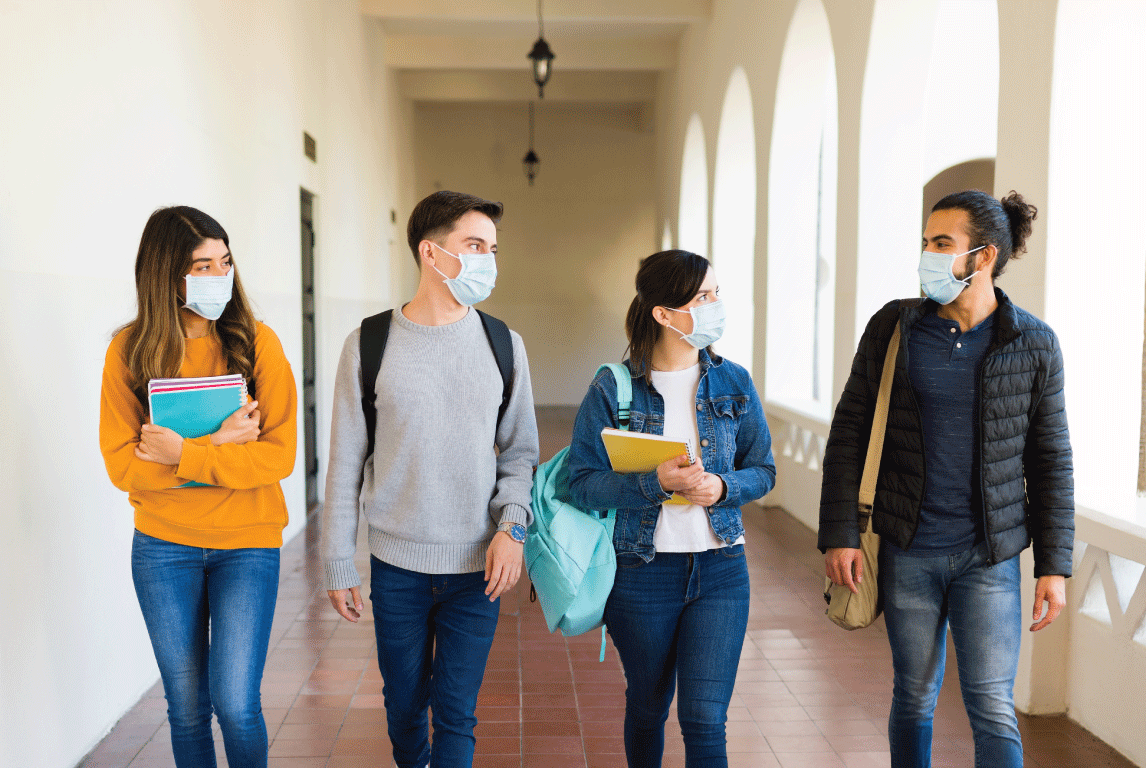
Over the past several months, higher education has been reminded that infectious disease threats did not disappear when the COVID-19 public health emergency ended. Recent events have included ongoing measles outbreaks in multiple states, cases of Legionnaires’ disease linked to building water systems in New York City, multi-state Cyclospora outbreaks associated with contaminated food, increasing concerns about avian influenza, and continued monitoring of emerging infectious diseases around the world.
While these events differ significantly in how they spread and how they are controlled, they all share one important lesson: colleges and universities must maintain the ability to recognize, respond to, and communicate during infectious disease events.
Why colleges and universities are particularly vulnerable
College campuses create an environment where communicable diseases can spread quickly. Thousands of students live, study, dine, exercise, and socialize in close proximity. Residence halls, classrooms, athletic facilities, dining halls, laboratories, and student events all increase opportunities for disease transmission.
Many campuses also have characteristics that increase complexity during an outbreak:
- Students converge from different states and countries, bringing various vaccination histories and levels of immunity.
- Large numbers of individuals travel during breaks and return to campus within a short period.
- The campus, health services, housing, dining, athletics, environmental health, academic affairs, communications, and public safety departments all play important roles in responding to infectious disease events.
- Medical and health science students may have additional risks associated with clinical placements, required immunizations, exposure to bloodborne pathogens, and other occupational health considerations.
An infectious disease event therefore becomes much more than a medical issue; it quickly becomes an operational, academic, communications, and business continuity challenge.
Pandemic planning is emergency management
One of the lessons learned from COVID-19 is that pandemic planning should not exist as a standalone document sitting on a shelf. Instead, it should be integrated into the institution’s broader emergency management and enterprise risk management programs.
Just as institutions prepare for severe weather, cybersecurity incidents, active threats, utility failures, or natural disasters, they should also maintain an infectious disease response framework that can be adapted to different situations.
The specific response to measles looks very different from the response to Legionella or Cyclospora. Yet many of the underlying capabilities remain the same:
- Clear incident command and decision-making structures
- Reliable internal and external communications
- Defined roles and responsibilities
- Surveillance and situational awareness
- Coordination with local and state public health agencies
- Continuity of operations planning
- Recovery planning and after-action reviews
Planning around broad functions rather than individual diseases makes organizations far more resilient.
Questions every campus should consider
Rather than waiting for the next public health emergency, institutions should periodically review their response plans and capacity, starting with some of the following questions:
- Are our infectious disease response plans current?
- Who serves on our multidisciplinary response team? Are student health, environmental health and safety, facilities, housing, dining, communications, risk management, athletics, academic leadership, and public safety appropriately represented?
- Do we know how we would rapidly communicate with students, parents, faculty, and staff?
- Are vaccination policies and verification processes up to date?
- How would we manage isolation, contact tracing (when appropriate), environmental remediation, or building closures?
- Have we conducted tabletop exercises within the past year?
- Are our plans inclusive of all student and faculty populations (e.g., students with disabilities, international students, commuters, and low-income students)?
These conversations often identify opportunities for improvement long before they are needed.
Helpful resources
Fortunately, institutions do not need to start from scratch. Several organizations provide outstanding guidance for infectious disease preparedness and emergency planning, including:
- The American College Health Association (ACHA)
- The Centers for Disease Control and Prevention (CDC)
- World Health Organization
- National Foundation for Infectious Disease
- State and local public health departments
Building a more resilient campus through Campus Health 360
Preparedness is not about predicting the next outbreak. It is about building systems that enable institutions to respond effectively regardless of the specific threat – a cornerstone of Campus Health 360. Through the growing ecosystem of experts and resources, Campus Health 360 is supporting the field of higher ed in building strong, sustainable, preventive systems to ensure healthy, resilient campuses everywhere.
Whether the next challenge involves measles, a foodborne outbreak, Legionella, influenza, norovirus, or a novel emerging pathogen, campuses that invest in planning, coordination, communication, and continuous improvement will be better positioned to protect and advance student health and well-being.
Resources:
- American College Health Association. (2026, July 8). Updated Emergency Planning Guidelines. Accessed on July 30, 2026. https://www.acha.org/news/updated-emergency-planning-guidelines-now-available/
- American College Health Association. (2026, Mar 16). Resources for Measles Outbreak Prevention and Response. Accessed on July 30, 2026. https://www.acha.org/news/resources-for-measles-outbreak-prevention-and-response/
- Centers for Disease Control and Preparedness. (n.d.). Preparing and Responding to Measles: Checklist for Institutions of Higher Education. Accessed on July 30, 2026. https://www.cdc.gov/measles/downloads/measles-checklist-institutions-higher-education.pdf
- Centers for Disease Control and Preparedness. (2024, Oct 29). Planning for Outbreaks, Epidemics, and Pandemics. Accessed on July 30, 2026. https://www.cdc.gov/children-and-school-preparedness/php/interventions/planning.html
- World Health Organization. (n.d.). Outbreak Toolkit. Accessed on July 30, 2026. https://www.who.int/emergencies/outbreak-toolkit
- National Foundation for Infectious Disease. (n.d.). Planning for Prevention: Tips to Manage Meningococcal Disease Outbreaks on Campus. Accessed on July 30, 2026. https://www.nfid.org/wp-content/uploads/2023/05/Meningococcal-Toolkit-Case-Response-Materials.docx.pdf

WFSTU-260842
