

In higher education, we often talk about improving student health through education, awareness campaigns, programs, and services. Orientation and peer education programs teach healthy habits. Counseling centers expand capacity. Wellness campaigns encourage students to make better choices.
These efforts matter. But the strongest and most reliable driver of population-level health improvement is not education alone: it is policy.
Policy works because it changes the environment in which decisions are made. Students, like all people, make choices within constraints. When policies alter access, affordability, convenience, and social norms, behavior changes—often quickly and at scale. In other words, policy does not just encourage healthier behavior. It makes healthier behavior easier and unhealthy behavior harder.1
Public health history repeatedly demonstrates a simple truth: when policies change, outcomes follow.
Tobacco: A clear cause-and-effect example
One of the most well-established examples is tobacco use. Over the past two decades, colleges have invested heavily in smoking prevention programs and peer education. Yet the most dramatic declines in smoking did not follow educational campaigns alone. They followed policy changes, specifically smoke-free laws and campus tobacco bans.
State and municipal indoor smoking restrictions reduced where smoking was allowed. Campuses then adopted smoke-free and later tobacco-free policies. These policies did several things simultaneously:
- Reduced opportunities to smoke
- Decreased social visibility and normalization of smoking
- Increased inconvenience
- Reinforced non-smoking as the expected social behavior
National College Health Assessment (NCHA) data over time reflect this shift. The proportion of college students reporting cigarette smoking has fallen substantially since the early 2000s.2 Public health research consistently shows that smoke-free policies reduce tobacco use prevalence and initiation, particularly among young adults.3 Importantly, students did not suddenly receive significantly better information about the dangers of smoking — what changed was the environment.
Policy shifted the default behavior.
Mental health care: Access is a policy decision
Policy influence becomes even clearer when we look at mental health care. For years, a major barrier to treatment was not stigma alone; it was coverage. Historically, insurance plans often imposed stricter limits on mental health services than on medical or surgical care. Higher copays, visit caps, and narrow networks made access difficult even when students wanted help.
Mental health parity laws fundamentally altered this environment.
The Mental Health Parity and Addiction Equity Act (MHPAEA), along with Affordable Care Act provisions, required many health plans to cover behavioral health services comparably to physical health care. This was not a counseling campaign or a wellness initiative. It was a policy change.
Research following the implementation of parity requirements has shown increased use of mental health services and reduced financial barriers to care.4,5 Among young adults, including college-age populations, expanded coverage under dependent coverage and parity provisions was associated with improved access to behavioral health treatment.6 Counseling centers did not suddenly convince students that therapy was beneficial; students were often already willing. The difference was that care became financially and structurally more accessible. Policy removed a barrier, and demand became more apparent.
Why this matters for college health
These examples illustrate a consistent pattern:
Education changes knowledge.
Programs change awareness.
Policy changes behavior.
College health systems operate within a unique environment where students are forming lifelong health habits. Because of this, policy decisions made by institutions, payers, and governments have a disproportionate long-term impact.
Policies influence:
- Whether students seek care early or delay treatment
- Whether mental health services are affordable
- Whether substance use is normalized or moderated
- Whether preventive care is routine or avoided
Importantly, policy also creates consistency. Programs depend on staff, funding cycles, and leadership priorities. Policies endure beyond individual initiatives and leadership turnover. They embed health into the structure of the institution.
Policy as a population health tool
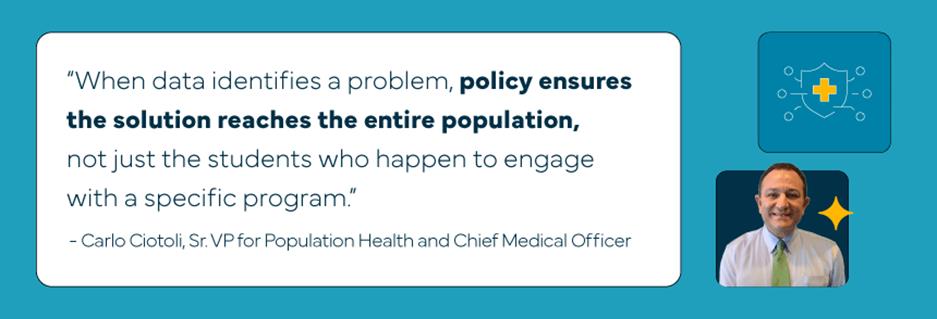
For organizations working in student health and insurance, policy is one of the most powerful population health tools available. Claims data may reveal patterns—rising anxiety treatment, delayed care, repeated emergency visits—but policy is often the mechanism that converts those insights into sustained improvement.
Examples might include:
- Coverage policies that eliminate barriers to preventive behavioral health visits
- Referral and care-coordination requirements between campus and community providers
- Coverage for tele-mental health services
- Vaccination and preventive care policies
- Standardized medical leave and return-to-learn frameworks
The takeaway
Health outcomes are not determined solely by personal choices. They are strongly shaped by the rules and structures surrounding those choices. Smoke-free laws reduced smoking. Alcohol policies reduced high-risk drinking. Mental health parity laws increased access to care. Policy works because it changes the system.
In college health—where well-being influences academic success, retention, and long-term life trajectory—policy is not merely administrative. It is clinical, preventive, and educational all at once. If we want durable improvements in student well-being, we must think beyond services and campaigns and focus on the environments we design.
The most effective health intervention is often not a new program. It’s a better policy.
Stay up to date with Campus Health 360
Being informed empowers you to actively support campus health initiatives and advocate for positive change. Stay updated on student health trends by subscribing to the Campus Health 360 Newsletter for monthly updates.

References
- Frieden, T. R. (2010). A framework for public health action: The health impact pyramid. American Journal of Public Health, 100(4), 590–595. https://doi.org/10.2105/AJPH.2009.185652
- American College Health Association. (2025). National College Health Assessment III: Undergraduate student reference group executive summary Spring 2025. American College Health Association.
- U.S. Department of Health and Human Services. (2014). The health consequences of smoking—50 years of progress: A report of the Surgeon General. U.S. Department of Health and Human Services.
- Barry, C. L., & Huskamp, H. A. (2011). Moving beyond parity — Mental health and addiction care under the ACA. New England Journal of Medicine, 365(11), 973–975. https://doi.org/10.1056/NEJMp1108649
- Busch, S. H., & Barry, C. L. (2008). New evidence on the effects of state mental health parity laws. Health Affairs, 27(2), 536–544. https://doi.org/10.1377/hlthaff.27.2.536
- Golberstein, E., Busch, S. H., & Sommers, B. D. (2015). Increased mental health treatment utilization among young adults after the Affordable Care Act dependent coverage provision. JAMA Psychiatry, 72(2), 186–193. https://doi.org/10.1001/jamapsychiatry.2014.2452
WFSTU-260395
