

Today’s college health challenges are complex and interconnected. Solving them requires a look through the systems thinking lens.
As I reflect on the summer, I keep coming back to two defining moments: the Knicks winning their first championship in 53 years, and countries from across the globe coming to the U.S. to compete in soccer’s quadrennial championship, the World Cup. Although they took place in very different arenas, both point to the same lesson: success is rarely the result of a single factor. It emerges from the strength of a system.
In a recent Healthiest Goldfish essay, Sandro Galea and Mohammed Abba-Aji used sports examples to illustrate how systems and structural choices compound over time, and ultimately shape outcomes.1 From how talent is identified, to how resources are distributed, the same is true in college health and well-being, where outcomes emerge from the interaction of many connected parts rather than from any single program, service, or intervention. This breaks down to a simple, yet powerful systems principle — that systems get the outcomes they are designed to get.
I’ve spent more than 30 years working in college health and higher education, and over that time I’ve had the opportunity to experience these systems from very different vantage points, from leading a complex student health system at the NYU Student Health Center to guiding multi-institution improvement collaboratives. Today, through my work at Wellfleet, I have another perspective — looking across institutions to see student health through the lenses of population health, data, healthcare delivery, technology, insurance, and partnerships.
These experiences have reinforced a lesson that I believe is increasingly important for higher education: The most important challenges in student health and well-being rarely belong to a single department, and they rarely have a single solution. They are complex system challenges.
What is a complex system?
A complex system is one in which multiple interconnected parts interact with one another in ways that produce outcomes that cannot be fully understood by looking at any one part in isolation. Relationships and context matter. Changes in one part of the system can create intended and unintended effects somewhere else.
There’s a clear parallel to a college campus, where students interact with academic programs, health services, counseling, student affairs, housing, food services, technology, insurance, transportation, financial systems, faculty, peers, and their surrounding communities. Rather than operating independently, these parts interact with each other, helping to shape student health, well-being, engagement, persistence, and success.
If the system is complex, then improving it requires more than adding another program — it requires a new approach.
From programs to systems
A systems approach asks different questions. Rather than simply asking, “What intervention should we implement?” We might ask:
- What is producing this outcome?
- Are goals aligned throughout the system?
- Where are the barriers?
- Is there a free flow of relevant information?
- How do the different parts of the system interact?
- Where are the handoffs and points of friction?
- What incentives or policies influence behavior?
- Where are there feedback loops?
- And where might we intervene to create the greatest impact?
But, asking these questions doesn’t automatically lead to systems change. Complex systems require disciplined approaches to improvement.
Quality improvement, implementation science, human-centered design, innovation methodologies, data and measurement, and other formal improvement frameworks give us ways to move from understanding a system to testing, learning, and changing it.
Systems-thinking in higher ed
The field of college health and well-being has been evolving toward systems thinking for years.
The Okanagan Charter, adopted in 2015, explicitly calls on higher education institutions to use “settings and whole system approaches,” develop interconnected strategies, engage stakeholders, and build transdisciplinary collaborations. It also calls for research, innovation, and evidence-informed action.2
And look at the language.
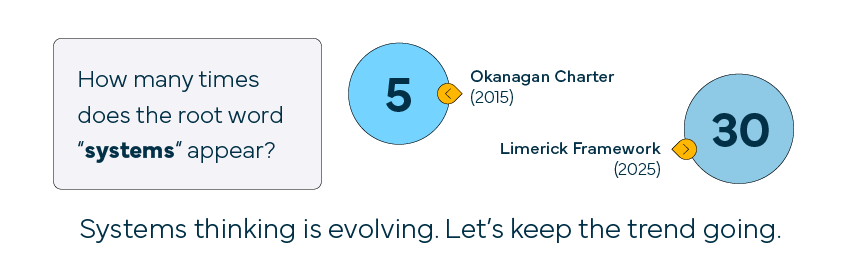
In the Okanagan Charter, words containing the root “system” appear five times.
Ten years later, the Limerick Framework for Action was launched in 2025 as the next chapter in the global health-promoting campuses movement, which explicitly calls for collective action across the entire higher education system and for systemic change.
In the framework, words containing “system” appear 30 times.
That evolution is telling. We increasingly understand that creating healthier campuses requires us to move beyond isolated interventions and toward whole-campus, interconnected, evidence-informed approaches.
Moving from frameworks to action
While we have the language, sophisticated frameworks, growing evidence, and passionate people doing extraordinary work on campuses every day, we lack the resources, tools, practical examples, expertise, and opportunities to learn from one another that make systems approaches easier to put into practice.
There’s an opportunity here to adapt our environments together, leveraging our joint expertise, sharing tools and resources, and growing partnership and collaborations, all in an effort to tackle the challenges that are too complex for any one organization to solve alone.
This isn’t about suggesting that every campus needs to look the same — in fact, quite the opposite. Nevertheless, systems approaches recognize that context matters.
The goal of my work is to provide ways of thinking, tools, and connections that campuses can adapt to their own systems. From bringing together expert insights, translating them to practical ideas, curating toolkits and models, and creating opportunity to collaboration, Campus Health 360 offers an opportunity to reshape our system to get the outcomes we want, not just the results we expect.
The challenges facing college health are complex — our approaches need to be, too. Let’s learn how to see the system, improve the system, and most importantly improve it together.
Check out our resources on systems thinking:
Article resources:
- Galea, S., Abba-Aji, M. (2026, Jul 18). On soccer, the World Cup, and the water we swim in. The Healthiest Goldfish, Substack. Accessed on August 27, 2026. https://www.sandrogalea.org/healthiestgoldfish/njp54sy5rrx9b7x-fmw67-hczzz-5yj5x-37zap
- Charters & Frameworks. (n.d.). U.S. Health Promoting Campuses Network. Accessed on August 26, 2026. http://ushpcn.org/okanagan-charter/

WFSTU-260981
